
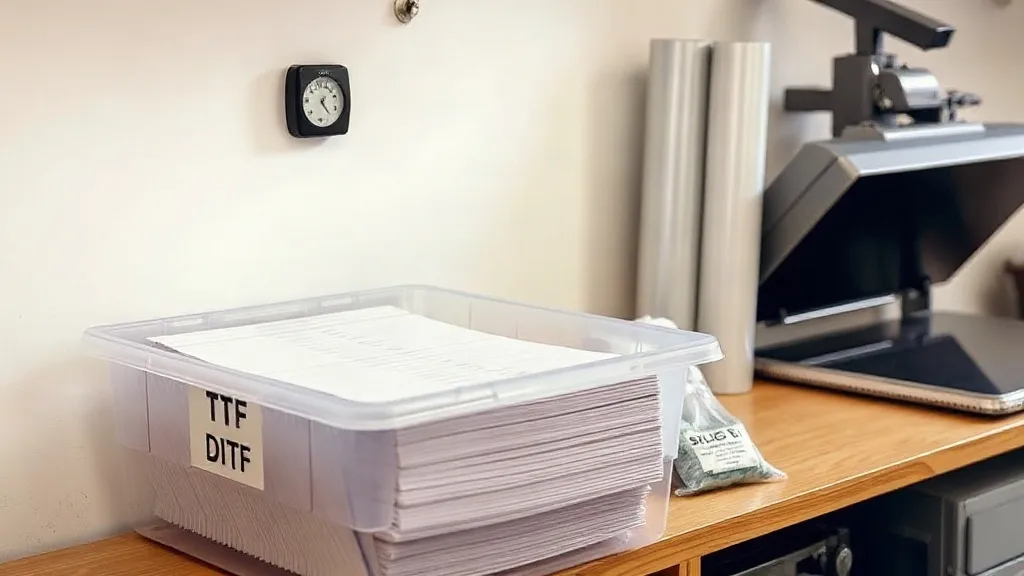
You've dialed in your powder shake, your cure time, and your press settings. The prints come off the shaker looking crisp, and the first shirt presses perfectly. Then a week later, a customer returns with a transfer that won't peel cleanly, or you pull a sheet from the stack and notice the powder has turned tacky. Nothing in your process changed. What changed was how the prints were stored. Storage is the quiet variable in dtf transfers, and it's the one most small shops ignore until a batch fails.
This guide covers the storage side of dtf printing: what actually degrades film and finished transfers, how to set up a storage routine that fits a real workspace, and how to spot a problem before it reaches a customer. No lab equipment required, just a few habits and a cheap hygrometer.
What Actually Degrades a DTF Transfer
Finished transfers are more fragile than they look. The printed ink layer is thermoplastic, the powder is a moisture-sensitive adhesive, and the film is a carrier that can absorb and release water. Three environmental factors do most of the damage.
Humidity
This is the big one. The adhesive powder used in dtf printing is hygroscopic, meaning it pulls moisture out of the air. In a humid room, powder that was fully cured can soften, clump, or turn slightly sticky on the surface. When that happens, the transfer may still press, but the bond is weaker and the peel can be ragged. A shop in a coastal climate can see this within days if prints are left out on an open table.
You don't need a climate-controlled room. You need to know your humidity and keep finished prints sealed when they're not being used. A $15 hygrometer on the wall tells you more about your storage risk than any forum thread.
Light and Heat
UV light and sustained heat both accelerate the breakdown of the ink layer. A stack of transfers sitting on a windowsill or near a heat press will degrade faster than the same stack in a closed drawer. The visible symptom is usually dulled color or a film that becomes brittle and curls at the edges. Neither is recoverable once it happens.
Pressure and Stacking
Stacking finished transfers directly on top of each other puts weight on the powder side. Over time, the powder can press into the film of the sheet above, and you get transfers that stick together or shed powder when you separate them. This is especially common when shops stack prints on a shelf for weeks between orders.
How to Store Unused Film
Unused dtf film has its own storage rules, and they're simpler than most people expect. The film itself is fairly stable, but the coated side is sensitive to dust, moisture, and physical contact.
- Keep film in its original packaging or a sealed bag until you're ready to print. Once opened, reseal it the same day.
- Store rolls upright, not lying flat. Flat storage puts pressure on the roll and can leave flat spots or creases that show up as banding in the print.
- Keep film away from direct sunlight and heat sources. A shelf above a dryer or press is the worst possible spot.
- Handle sheets by the edges. Fingerprints on the coated side can cause powder to adhere unevenly, which shows up as patchy areas after pressing.
If you buy film in bulk to save money, this is where the savings can backfire. A year's supply stored badly is worse than a month's supply stored well. Buy in quantities you'll actually use within a few months, and store the rest properly.
How to Store Finished Transfers
Finished transfers need more care than raw film because the powder layer is now exposed and active. The goal is to keep them dry, flat, and separated.
The Interleaving Habit
Place a sheet of clean, unprinted paper or a piece of silicone-coated backing paper between each finished transfer. This prevents powder-to-film contact and stops transfers from bonding to each other under weight. It takes a few seconds per sheet and saves entire batches.
Seal Them, Don't Just Stack Them
Once transfers are cool and cured, move them into a sealed bag or a lidded plastic bin with a desiccant packet. This is the single most effective step against humidity. A zip-top bag with a silica gel pack will keep a batch stable for months in most home workshops. Label the bag with the print date so you can rotate stock.
Store Flat, Not Folded
Folded or rolled transfers can develop creases in the ink layer that show up as lines after pressing. Store them flat in a drawer, a bin, or a dedicated folder. If you're shipping transfers to a customer, use a rigid mailer and keep the interleaving paper in place.
Setting Up a Storage Station That Fits Your Shop
You don't need a dedicated room. A single drawer or a lidded bin near the press is enough if you set it up deliberately.
- Pick a dry, dark spot. Away from windows, presses, dryers, and sinks. A closed cabinet in the main work area is usually fine.
- Add a hygrometer. Mount it where you can see it. Aim to keep the storage area under about 60% relative humidity; above that, use desiccant and reseal more aggressively.
- Use bins with lids. Clear bins let you see stock levels without opening them. Keep a desiccant pack in each bin and replace it when the indicator changes color.
- Label everything. Print date, film type, and quantity on each bag. First in, first out is the rule that keeps old stock from becoming waste.
- Do a weekly check. Open one bag, feel the powder surface, and look for clumping or curling. Two minutes a week catches problems before they cost you a customer.
Shipping Transfers Without Ruining Them
If you sell transfers online, storage rules apply in transit too. Heat and humidity inside a delivery truck or mailbox can undo weeks of careful storage in a single afternoon. Use rigid mailers, keep the interleaving paper in place, and add a small desiccant pack to each order. For larger orders, a flat box with the transfers sandwiched between cardstock is more reliable than a padded envelope. If you're looking for dtf transfers near me as a customer, ask the supplier how they ship; a shop that ships flat and sealed is usually a shop that stores properly too.
How to Tell If a Stored Transfer Is Still Good
Before pressing an older transfer, do a quick check. Feel the powder side: it should be dry and slightly rough, not tacky or slick. Look at the edges of the film for curling or yellowing. Press one test piece onto a scrap garment and do a peel while warm; if the peel is clean and the print is fully transferred, the batch is fine. If the powder feels sticky or the peel leaves residue, the transfer has absorbed moisture and should not go to a customer.
One test press costs a few cents. A returned order costs a customer. Run the test.
Frequently Asked Questions
How long can I store finished DTF transfers before they go bad?
In a sealed bag with a desiccant pack and stored away from light and heat, most finished transfers stay press-ready for several months. In an open stack in a humid room, quality can drop within a week or two. The storage conditions matter far more than the calendar.
Can I freeze DTF transfers to make them last longer?
Freezing isn't recommended. Condensation when the transfers come back to room temperature can introduce moisture directly onto the powder, which is the exact problem you're trying to avoid. Cool, dry, and dark is the right combination; cold and wet is not.
Why do my stored transfers stick together?
Powder-to-film contact under weight is the usual cause. Interleaving paper between sheets and storing flat rather than stacked solves it. If transfers are already stuck, don't force them apart; the powder layer will tear. Test-press one to see if the bond is still intact before using the rest.
Does the powder side need to be covered during storage?
Yes. The powder side is the active adhesive layer and is the most vulnerable part of the transfer. A sealed bag or a lidded bin keeps dust, moisture, and accidental contact off it. Leaving finished transfers powder-side up on an open shelf is the fastest way to ruin a batch.
Can I store DTF transfers in the same room as my heat press?
It's not ideal. A press radiates heat and the room around it often runs warmer and more humid than the rest of the shop. If you have no other option, keep transfers in a sealed bin on the far side of the room and check humidity more often. A cabinet or drawer away from the press is a better long-term home.